
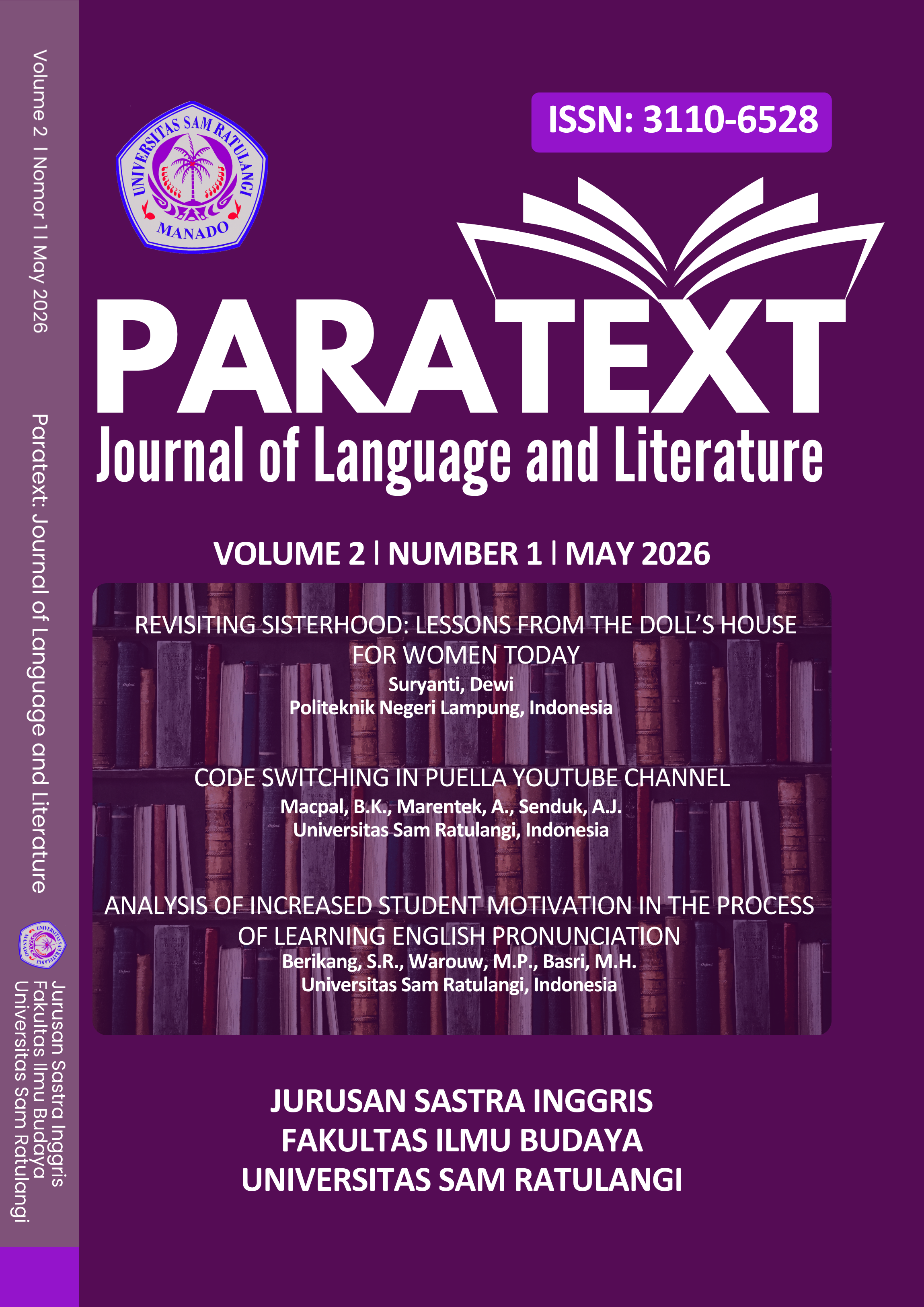
REVISITING SISTERHOOD: LESSONS FROM THE DOLL’S HOUSE FOR WOMEN TODAY
DOI:
https://doi.org/10.35796/pj.v2i1.61294Keywords:
Sisterhood, Twisted Sisterhood, Short Story, Cyberbullying, The Doll's HouseAbstract
This paper explores the urgency of sisterhood in the context of women's lives in the digital era, particularly amidst the growing vulnerability of women to cyberbullying. In such conditions, women need a safe spaces that enable mutual support and the building of solidarity. However, the phenomenon shows that such solidarity often fails to materialize, and is instead replaced by acts of hostility among women, which in feminist discourse is known as twisted sisterhood. This research employs a feminist literary criticism approach, grounded in sisterhood theory, to analyze Katherine Mansfield’s short story The Doll’s House as the primary data, and connects the literary analysis with social phenomena through an intertextual approach. Secondary data, including studies on twisted sisterhood and media reports on cyberbullying among women, are utilized to establish the link between literary texts and social realities. Thus, this study not only analyzes literary texts as aesthetic works but also emphasizes the relevance of literature in interpreting the social issues faced by women today. The dynamics of sisterhood and twisted sisterhood are clearly reflected in the short story The Doll’s House by Katherine Mansfield. The story portrays the relationships among female characters that are laden with social class tensions, prejudice, and the failure to foster solidarity, elements that can be reflected in contemporary social realities. This literary work serves as a mirror for readers, especially women, to reevaluate how women can either empower or hinder one another in their shared struggle against discrimination.
Downloads
Published
Issue
Section
License
Copyright (c) 2026 Dewi Suryanti

This work is licensed under a Creative Commons Attribution 4.0 International License.