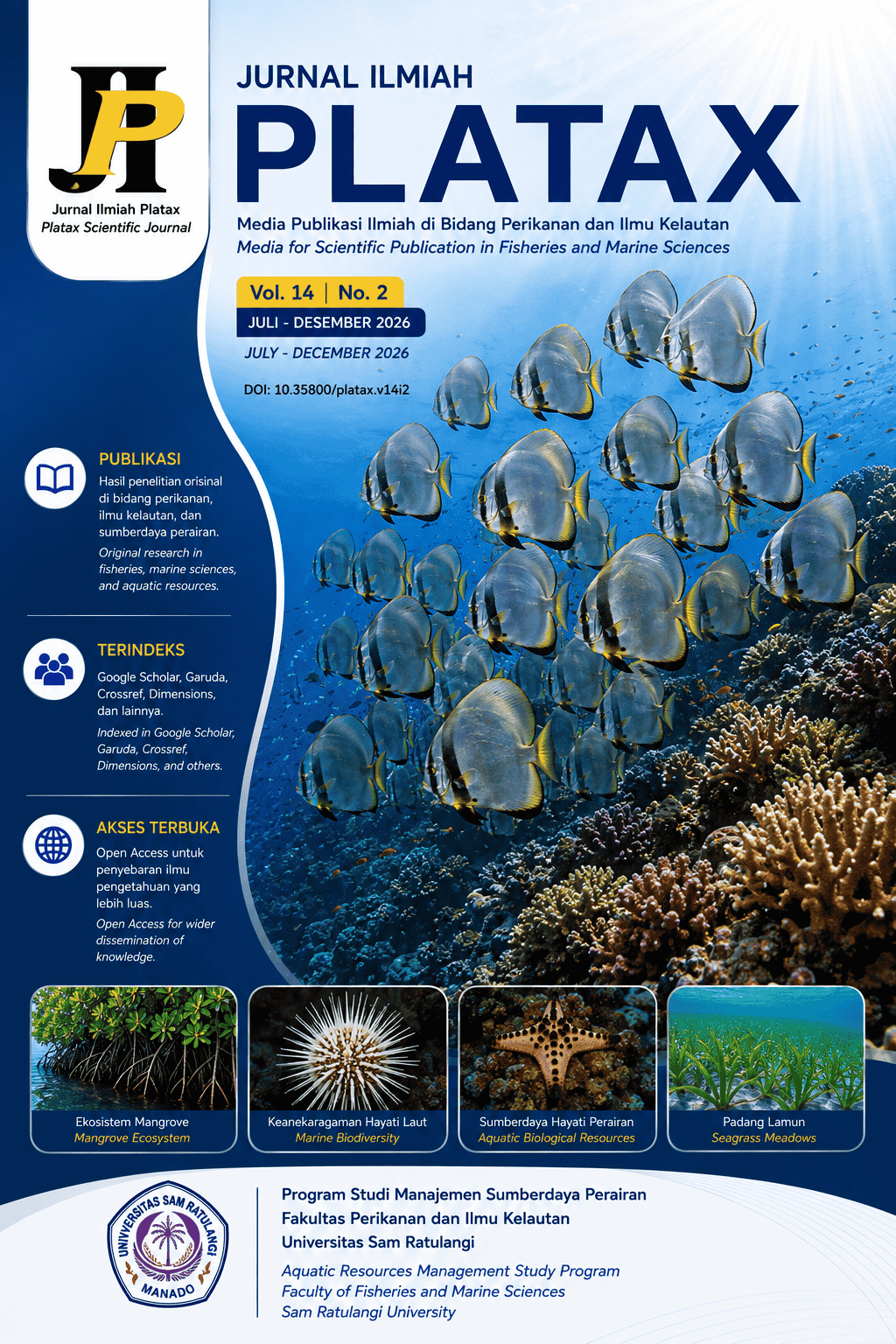
Application of Fish Traps on Artificial Reefs in Manado Bay
DOI:
https://doi.org/10.35800/jip.v14i2.68500Keywords:
combined trap, artificial reef, reef fish, diversity, sustainable fisheriesAbstract
Reef fish resources hold significant ecological and economic value, yet they are vulnerable to pressure from the use of unsustainable fishing gear. This study aims to analyze the effectiveness of a combined artificial reef fish trap compared to conventional traps in catching reef fish, as well as to evaluate the fish community structure based on diversity, evenness, and dominance indices. The research was conducted in the waters of Malalayang Satu, Manado Bay, in February 2026, employing an experimental method with two treatments: conventional traps and combined artificial reef traps. Observations were made on the number of species, number of individuals, and catch biomass. Data were analyzed using the Shannon-Wiener diversity index (H'), evenness index (E), and dominance index (C). The results showed that 16 fish species from 10 families were caught. Diversity values were categorized as moderate for both conventional traps (H' = 2.08) and combined traps (H' = 1.50), with low dominance indices across both treatments. Although the number of species caught in the combined traps was lower, this treatment yielded a higher number of individuals and biomass compared to conventional traps. The findings indicate that the combined artificial reef fish trap has the potential to enhance reef fish catch effectiveness and can be developed as an eco-friendly fishing gear alternative to support sustainable fisheries management in coastal areas.
Downloads
References
Asril, M., Simarmata, M. M. T., Sari, S. P., Indarwati, Setiawan, R. B., Afriansyah, A., & Junairiah. (2022). Keanekaragaman Hayati. Yayasan Kita Menulis.
Awuy, G., Rondonuwu, A. B., & Kambey, A. D. (2017). Komunitas ikan karang pada terumbu buatan di perairan Kareko Kecamatan Lembeh Utara Kota Bitung Provinsi Sulawesi Utara. Jurnal Ilmiah Platax, 5(2), 145-154. https://ejournal.unsrat.ac.id/index.php/platax.
Badan Pusat Statistik. (2025). Statistik Pelabuhan Perikanan 2024 (Volume 8). Badan Pusat Statistik.
Dao, Y. (2023). Indonesia Sebagai Negara Kepulauan Berdasarkan UNCLOS 1982.
Ernaldi, T. A. (2017). Analisis Alat Tangkap Ramah Lingkungan di Tempat Pelelangan Ikan (TPI) Panggung Jepara. Journal of Fisheries Resources Utilization Management and Technology, 6(4), 291-300.
Fawwaz, M. N., & Rahim, A. R. (2025). Keanekaragaman jenis ikan hasil tangkapan nelayan di Pelabuhan Perikanan Pantai Campurejo Kabupaten Gresik. Jurnal Perikanan Pantura (JPP), 8(1), 630.
Haruna, H., Hehanussa, K. G., & Tuhumena, L. (2024). Analisis hasil tangkapan bubu dasar berdasarkan lokasi penangkapan ikan di perairan Seram Bagian Barat, Maluku. ACROPORA: Jurnal Ilmu Kelautan dan Perikanan Papua, 7(1), 28-36. https://doi.org/10.31957/acr.v7i1.3668
Hehanussa, K. G., Martasuganda, S., & Riyanto, M. (2017). Selektivitas bubu buton di perairan Desa Wakal, Kabupaten Maluku Tengah. ALBACORE Jurnal Penelitian Perikanan Laut, 1(3), 309-320.
Hutubessy, B. G., & Mosse, J. W. (n.d.). An experimental fishing operation of collapsible trap for capture of coral fish [Uji coba pengoperasian bubu lipat untuk penangkapan ikan karang. Jurnal Perikanan (J. Fish. Sci.), 9(2), 267-273.
Kementerian Kelautan dan Perikanan. (2021). Peraturan Menteri Kelautan dan Perikanan Republik Indonesia Nomor 18 Tahun 2021 tentang Penempatan Alat Penangkapan Ikan dan Alat Bantu Penangkapan Ikan di Wilayah Pengelolaan Perikanan Negara Republik Indonesia dan Laut Lepas serta Penataan Andon Penangkapan Ikan. Jakarta: KKP.
Nanlohy, A. C. (2018). Perbandingan hasil tangkapan bubu pada jenis terumbu buatan ban dan bambu di perairan Desa Toisapu Kecamatan Baguala Ambon. PAPALELE: Jurnal Penelitian Sosial Ekonomi Perikanan dan Kelautan, 2(2), 58-69.
Paillin, J. B., Haruna, H., & Tuhumury, J. (2023). Keanekaragaman jenis ikan demersal yang tertangkap dengan bubu di perairan Negeri Wassu, Kabupaten Maluku Tengah. AMANISAL: Jurnal Teknologi dan Manajemen Perikanan Tangkap, 12(1), 27-32.
Riansyah, A., Hartono, D., & Kusuma, A. B. (2018). Ikan kepe-kepe (Chaetodontidae) sebagai bioindikator kerusakan perairan ekosistem terumbu karang Pulau Tikus. Majalah Ilmiah Biologi Biosfera: A Scientific Journal, 35(2), 103–110. https://doi.org/10.20884/1.mib.2018.35.2.480
Schwerdtner Máñez, K., & Husain Paragay, S. (2013). First evidence of targeted moray eel fishing in the Spermonde Archipelago, South Sulawesi, Indonesia. TRAFFIC Bulletin, 25(1), 4-7.
Siregar, I. H. K. (2018). Pengembangan Teknologi Penangkapan Ikan Yang Bertanggung Jawab Di Perairan Kabupaten Labuhanbatu Provinsi Sumatera Utara. Jurnal Perikanan Dan Kelautan, 23(1), 57-68.
Suruwaky, A. M., et al. (2025). Evaluation of the effectiveness and sustainability of modified trap (bubu) designs for demersal fish capture in Jefman Island, Southwest Papua. AGRIKAN: Jurnal Agribisnis Perikanan, 18(1), 320-326. https://doi.org/10.52046/agrikan.v18i1.320-326
Taurusman, A. A., & Wiryawan, B. (2021). Dampak Penangkapan Terhadap Ekosistem: Landasan Pengelolaan Perikanan Berkelanjutan. ALBACORE Jurnal Penelitian Perikanan Laut, 4(1), 109-118. https://doi.org/10.29244/core.4.1.109-118.
Downloads
Published
Issue
Section
Categories
License
Copyright (c) 2026 Christi M W Kowaas, Patrice N.I. Kalangi, Unstain N. J. W. Rembet, Deiske A. Sumilat, Hariyani Sambali, Vivanda O. J. Modaso

This work is licensed under a Creative Commons Attribution-NonCommercial 4.0 International License.
COPYRIGHT
Authors who publish with this journal agree to the following terms:
Authors hold their copyright and grant this journal the privilege of first publication, with the work simultaneously licensed under a Creative Commons Attribution License that permits others to impart the work with an acknowledgment of the work's origin and initial publication by this journal.
Authors can enter into separate or additional contractual arrangements for the non-exclusive distribution of the journal's published version of the work (for example, post it to an institutional repository or publish it in a book), with an acknowledgment of its underlying publication in this journal.
Authors are permitted and encouraged to post their work online (for example, in institutional repositories or on their website) as it can lead to productive exchanges, as well as earlier and greater citation of the published work (See The Effect of Open Access).