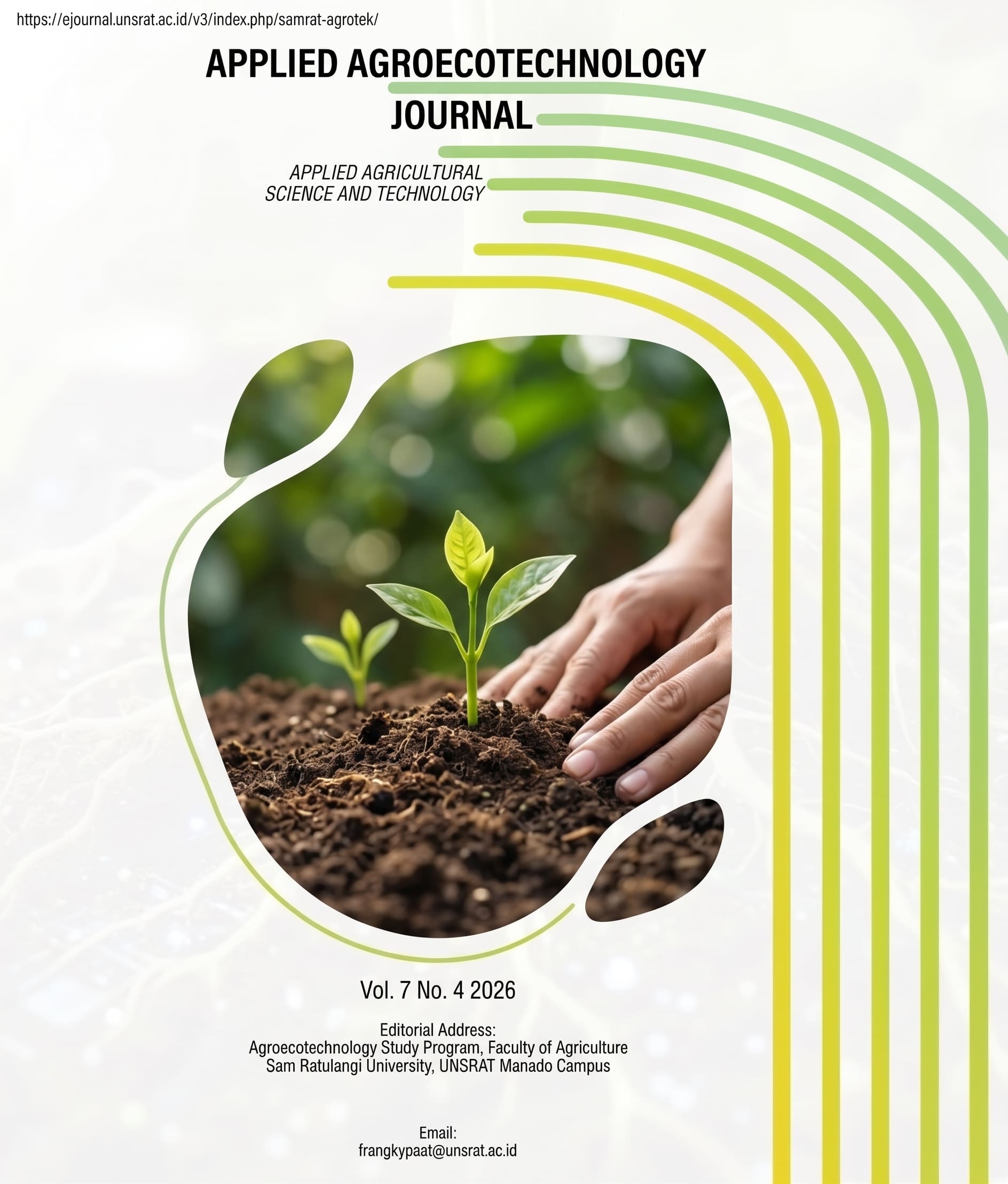
Dipteran taxa captured in pineapple-waste eco-enzyme traps in a chili field in Tomohon, Indonesia
DOI:
https://doi.org/10.35791/jat.v7i4.70751Keywords:
chili, Diptera, eco-enzyme, non-target insects, pineapple wasteAbstract
Field traps containing fermented fruit-waste preparations may capture both target agricultural pests and other Diptera, but the composition of these captures is not always documented. This study described dipteran taxa recorded from pineapple-waste eco-enzyme traps in a fruiting chili field in Kakaskasen Satu, Tomohon, Indonesia. The field survey reported five replicates and four observation rounds at seven-day intervals. Traps were suspended approximately 1.5 m above ground, spaced 5 m apart, and examined for adult flies. Seven taxa from five families were recorded. The reported mean catches were 21.25 individuals for Chrysomya megacephala, 16.80 for Drosophila melanogaster, 7.80 for Micropeza grallatrix, 3.20 for M. lateralis, 2.80 for Musca domestica, 1.55 for Bactrocera dorsalis, and 0.80 for Zeugodacus cucurbitae (reported previously as B. cucurbitae). The two tephritid fruit-fly taxa had lower reported catches than several non-target Diptera. The results document a taxonomically mixed trap catch rather than evidence of selective attraction or pest suppression. These descriptive observations provide a basis for further controlled evaluation of pineapple-waste preparations as potential monitoring baits in chili agroecosystems.
References
Antonatos, S., Lytra, I., Tselou, E., Anastasaki, E., Kokmotou, A., Psoma, A., Milonas, P., & Papachristos, D. P. (2026). Attractiveness and ovipositional responses of volatile organic compounds from preferred host fruits to Bactrocera dorsalis (Diptera: Tephritidae). Journal of Economic Entomology, 119(3), 1860–1868. https://doi.org/10.1093/jee/toag040
Benny, N., Shams, R., Dash, K. K., Pandey, V. K., & Bashir, O. (2023). Recent trends in utilization of citrus fruits in production of eco-enzyme. Journal of Agriculture and Food Research, 13, 100657. https://doi.org/10.1016/j.jafr.2023.100657
Dzialo, M. C., Arumugam, S., Piampongsant, S., Cool, L., Vanderaa, C., Herrera-Malaver, B., Opsomer, T., Dehaen, W., Wenseleers, T., Roncoroni, M., Alawamleh, A., Wäckers, F., Lievens, B., Hansson, B. S., Voordeckers, K., Sachse, S., & Verstrepen, K. J. (2024). Drosophila suzukii and Drosophila melanogaster prefer distinct microbial and plant aroma compounds in a complex fermented matrix. iScience, 27(11), 111141. https://doi.org/10.1016/j.isci.2024.111141
Duan, Y., Li, A., Zhang, L., Yin, C., Li, Z., & Liu, L. (2024). Attractant potential of Enterobacter cloacae and its metabolites to Bactrocera dorsalis (Hendel). Frontiers in Physiology, 15, 1465946. https://doi.org/10.3389/fphys.2024.1465946
Enkerlin, W., Arevalo, E., Caballero, J. E., Fezza, T., Garavelli, E., Martinez, D. B., Rodriguez, P. A., Shelly, T., Thomas, M. E., Villaseñor, A., & Flores, S. (2025). Searching for more effective food baits for tephritid fruit flies (Diptera: Tephritidae): Performance of newly developed vial-lures relative to torula yeast borax. Insects, 16(1), 53. https://doi.org/10.3390/insects16010053
Gumilar, G. G., Kadarohman, A., Fakhrurozi, M. F., Nahadi, Supriyanti, F. M. T., & Munawaroh, H. S. H. (2025). Characterization and enzymatic evaluation of ecoenzyme derived from fruit and vegetable waste: An effort to achieve zero waste concept. Baghdad Science Journal, 22(4), 1175–1184. https://doi.org/10.21123/bsj.2024.10707
Henneken, J., Farnier, K., & Cunningham, J. P. (2022). A synthetic blend of fruit and live yeast odours shows promise for trapping mated female Queensland fruit fly, Bactrocera tryoni, in the field. Journal of Chemical Ecology, 48, 817–826. https://doi.org/10.1007/s10886-022-01387-x
Ismail, A. Y., Nainggolan, M. F., Aminudin, S., Siahaan, R. Y., Dzulfannazhir, F., & Sofyan, H. N. (2024). Characterization of chemical composition of eco-enzyme derived from banana, orange, and pineapple peels. Brazilian Journal of Biology, 84, e286961. https://doi.org/10.1590/1519-6984.286961
Jayanthi, P. D. K., Kumar, P. S., & Vyas, M. (2021). Odour cues from fruit arils of Artocarpus heterophyllus attract both sexes of oriental fruit flies. Journal of Chemical Ecology, 47(6), 552–563. https://doi.org/10.1007/s10886-021-01269-8
Keene-Snickers, A. H., Dunham, T. J., & Stenglein, M. D. (2025). Experimental assessment of 3D-printed traps and chemical attractants for the collection of wild Drosophila melanogaster. Fly, 19(1), 2502184. https://doi.org/10.1080/19336934.2025.2502184
Ling, J., Li, Y., Zheng, X.-L., Lu, W., & Wang, X.-Y. (2024). Electroantennographic and behavioral responses of Bactrocera dorsalis (Diptera: Tephritidae) adults to the volatiles of plum fruits. Journal of Economic Entomology, 117(6), 2400–2412. https://doi.org/10.1093/jee/toae225
Liu, L., Yang, L., Yuan, J., Zhang, J., Liu, C., Zhou, H., Liu, W., & Wang, G. (2024). D-Limonene is the active olfactory attractant in orange juice for Bactrocera dorsalis (Insecta: Diptera: Tephritidae). Life, 14(6), 713. https://doi.org/10.3390/life14060713
Mobarak, S. H., Basit, A., Wu, L., Khurshid, A., Gui, S.-H., Hu, C.-X., & Liu, T.-X. (2025). Identification of a potent attractant and oviposition stimulant blend for Bactrocera dorsalis for sustainable pest management. Scientific Reports, 15, 13649. https://doi.org/10.1038/s41598-025-96277-z
Paat, F. J., & Sintaro, S. (2026). Solvent-dependent GC–MS fingerprinting of lipophilic constituents in Syzygium polyanthum leaves: A baseline study for future greener extraction optimization. Molecules, 31(11), Article 1932. https://doi.org/10.3390/molecules31111932
Paat, F. J., Wahyuni, H., Sapii, N. O., Tumbelaka, S., Watung, J. F., & Wantasen, S. (2024). Analysis of biopesticide active compounds in Barringtonia asiatica L. Kurz using the GC-MS method. IOP Conference Series: Earth and Environmental Science, 1302(1), Article 012009. https://doi.org/10.1088/1755-1315/1302/1/012009
Paat, F. J., Wantasen, S., Toding, M. M., Pakasi, S. E., Tumbelaka, S., Kaligis, J. B., Turang, D. A. S., Porong, J. V., & Linggi, R. J. (2023). GC-MS method for identification of organic chemical compounds nutmeg flesh of North Minahasa local varieties. IOP Conference Series: Earth and Environmental Science, 1241(1), Article 012004. https://doi.org/10.1088/1755-1315/1241/1/012004
Patoni, I., Sudarjat, Susanto, A., & Hidayat, Y. (2022). Potential of fruit extracts as attractants of female oriental fruit flies. Pakistan Journal of Biological Sciences, 25(6), 537–548. https://doi.org/10.3923/pjbs.2022.537.548
Ren, L., Jocelin, N. F., Yang, F., Zhang, X., Shang, Y., Feng, Y., Chen, S., Zhan, W., Yang, X., Li, W., Song, J., Tang, H., Wang, Y., Wang, Y., Zhang, C., & Guo, Y. (2025). Chromosome-level genome assembly of the synanthropic fly Chrysomya megacephala: Insights into oviposition location. BMC Genomics, 26, 442. https://doi.org/10.1186/s12864-025-11645-3
Shelly, T. E. (2026). Modifications to torula yeast borax-baited traps and their impact on the attraction of tephritid fruit flies (Diptera: Tephritidae). Journal of Insect Science, 26(3), ieag043. https://doi.org/10.1093/jisesa/ieag043
Syamsudin, T. S., Kirana, R., Karjadi, A. K., & Faizal, A. (2022). Characteristics of chili (Capsicum annuum L.) that are resistant and susceptible to oriental fruit fly (Bactrocera dorsalis Hendel) infestation. Horticulturae, 8(4), 314. https://doi.org/10.3390/horticulturae8040314
Thomas, D. B. (2003). Nontarget insects captured in fruit fly (Diptera: Tephritidae) surveillance traps. Journal of Economic Entomology, 96(6), 1732–1737. https://doi.org/10.1603/0022-0493-96.6.1732
Wanta, N. N., Paruntu, M. H. B., & Krisen, J. (2026). Field performance of fruit-waste eco-enzyme baits for trapping Bactrocera spp. in chili (Capsicum frutescens L.) fields of Tomohon City, Indonesia. Jurnal Agroekoteknologi Terapan, 7(1), 206–212. https://doi.org/10.35791/jat.v7i1.66769
Downloads
Published
Issue
Section
License
Copyright (c) 2016 Annatje Engelien B. Inkiriwang, Meisye Helmie Bettie Paruntu, Noni N. Wanta

This work is licensed under a Creative Commons Attribution-NonCommercial 4.0 International License.

This work is licensed under a Creative Commons Attribution-NonCommercial 4.0 International License.